


The reality of London tap water
London's tap water is considered safe to drink and among the most closely monitored supplies in the world. Thousands of samples a day are tested to ensure it meets the UK' s Water Supply (Water Quality) Regulations, enforced by the Drinking Water Inspectorate (DWI). These standards are based on scientific evidence and international health guidance.
Yet, "safe" doesn't always mean perfect taste or ideal composition for everyone. Many Londoners notice the distinctive "hard water" feel or a hint, or more of chlorine. That's where understanding your water - and knowing how to improve it - can make all the difference.
Here's an important distinction: water might be safe to drink, but is it truly healthy? Meeting minimum regulatory standards is one thing; optimising your water for vitality and wellbeing is another. This is precisely where Water for Health can help - by transforming compliant water into better hydrating water that supports your health goals.
At Water for Health, we believe hydration should not only be safe but healthy. We believe that systems that purely clean the water of chemical contaminsnts are only part of the story. Let’s explore what makes London’s tap water safe, what might affect its taste, and how simple changes can help you experience water at its best.
Key Takeaways
- London tap water meets rigorous UK regulations and is safe to drink for most people.
- Hardness (calcium and magnesium) influences taste and limescale, not safety.
- A small amount of chlorine maintains hygiene but may affect flavour and odour of the water.
- In older properties with legacy plumbing, a certified filter adds reassurance.
- Installing a high-quality filter from Water for Health elevates everyday hydration.
Did you know London's water is classified as very hard across most boroughs, yet remains safe and high quality? However like most other public water supplies they comply with regulatory requirements in terms of the levels of individual contaminants such as heavy metals, pesticide residues, hormones etc. However there is little or no testing as regards the potential adverse effect of a combination of contaminants that could all be individually compliant.
How tap water is tested and regulated
London's supply is managed primarily by Thames Water, which sources most of its water from the River Thames and local reservoirs. The company performs around 500,000 quality tests every year, checking for bacteria, chemicals, and minerals.
The essentials of UK water safety
|
Parameter |
What it Means |
Legal Limit |
What’s Typical in London |
|
Microbiological safety |
Absence of harmful bacteria such as E. coli |
0 per 100ml |
0 per 100ml |
|
Nitrate level |
Indicator of agricultural runoff |
50 mg/L |
< 25 mg/L |
|
Chlorine |
Used for disinfection |
No legal limit (kept low) |
0.1–0.5 mg/L |
|
Hardness |
Naturally occurring calcium & magnesium |
Not regulated |
250–300 mg/L CaCO₃ |
All public suppliers must report test results to the DWI, ensuring full transparency and compliance. In short, London tap water meets strict European and UK standards for safety.
Taste, hardness and trace elements
Even with excellent safety scores, water in the capital can taste or feel different from what you may experience elsewhere.
Why London's water tastes different
- Hardness: Much of London's water passes through chalk and limestone, picking up calcium and magnesium. These minerals can leave limescale in kettles or showers but are harmless and even beneficial in moderate amounts.
- Chlorine: A small amount is added to maintain hygiene through the pipe network. Sensitive drinkers might notice a taste or smell.
- Pipes and plumbing: In older buildings, pipe materials can subtly affect flavour, though still within legal limits.
If you prefer smoother, fresher-tasting water, a good-quality filter system can reduce these effects.
Who might want to be extra cautious
For most people, there's no reason to avoid London's tap water. However, a few circumstances call for additional attention:
- Old plumbing or lead pipes: Some pre-1970s properties may still contain lead pipework. It's sensible to check and, if needed, use a lead-removal certified filter.
-
Weakened immune systems: People with specific health conditions may wish to discuss extra filtration with their healthcare provider.
- Stored water: Flats with roof tanks should ensure these are covered, clean, and regularly maintained.
Simple habits such as using the cold kitchen tap for drinking, or running the water briefly after periods of non-use, further ensure quality.
How a filter can enhance your water experience
At Water for Health, we don't view filtration as a reaction to unsafe water - it's a proactive way to optimise what nature and regulation already provide.
What a filter can do
- Reduce chlorine taste and odour
- Minimise sediment, including microplastics
- Remove or reduce trace metals (depending on model) and organic contaminants
- Provide a fresher, mountain spring feel
- Improve clarity for better-tasting tea, coffee, and cooking water
There are a number of options available to reduce the levels of hardness in the water that can be integrated into water filtration processes.
How it works
Most modern filters use multi-stage cartridges combining:
-
Activated carbon - absorbs chlorine and organic compounds
-
Ion exchange resin - softens water and helps control scale
-
Fine mechanical filtration - captures small particles or sediment
While many water filter companies stop at basic filtration, Water for Health goes beyond simply removing contaminants. We focus on enhancing water's natural properties to support optimal health and vitality, essentially a combination of filtration, mineralisation and water structuring.
Our carefully designed range includes innovative solutions you won't find everywhere:
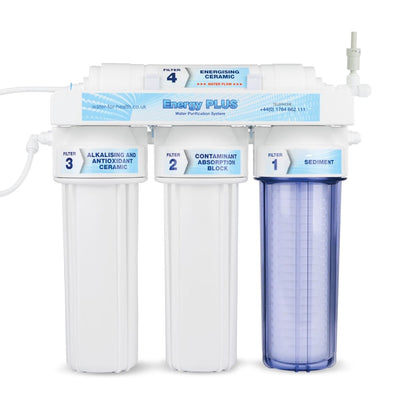
- Advanced ultrafiltration technology: Some of our systems, such as the Energy Plus, incorporate ultrafiltration membranes that filter out particulates down to 0.1 microns. This level of filtration provides an effective barrier against rust, fine particles, certain harmful bacteria, and microplastics - an increasing concern in modern water supplies. This advanced filtration removes contaminants that standard carbon filters simply cannot catch.
- Bioceramic technology: Our filters use advanced bioceramic minerals developed over 30+ years of research. Unlike standard filters that leave water slightly acidic, Biocera cartridges naturally alkalise water (pH 8.5-9.5) while infusing it with molecular hydrogen for antioxidant properties. The natural minerals improve water structure at a molecular level, making it more easily absorbed by your cells.
- Natural Action structured water devices: Water for Health is the UK distributor for Natural Action Technologies, who pioneered flow form technology that recreates nature's vortex motion. These devices use dual-helix vortexing to restore water's natural energy and structure - the same way water revitalises itself in mountain streams. This is combined with the action of special minerals and crystals that are known to enhance water structure. Many customers describe structured water as feeling "lighter" and more refreshing to drink.
- A holistic approach to hydration: Rather than focusing solely on what we remove from water, we also enhance what remains. Our systems can increase beneficial minerals (calcium, magnesium, potassium) , restore natural water molecular organisation, and create water that works better with your body's natural processes.
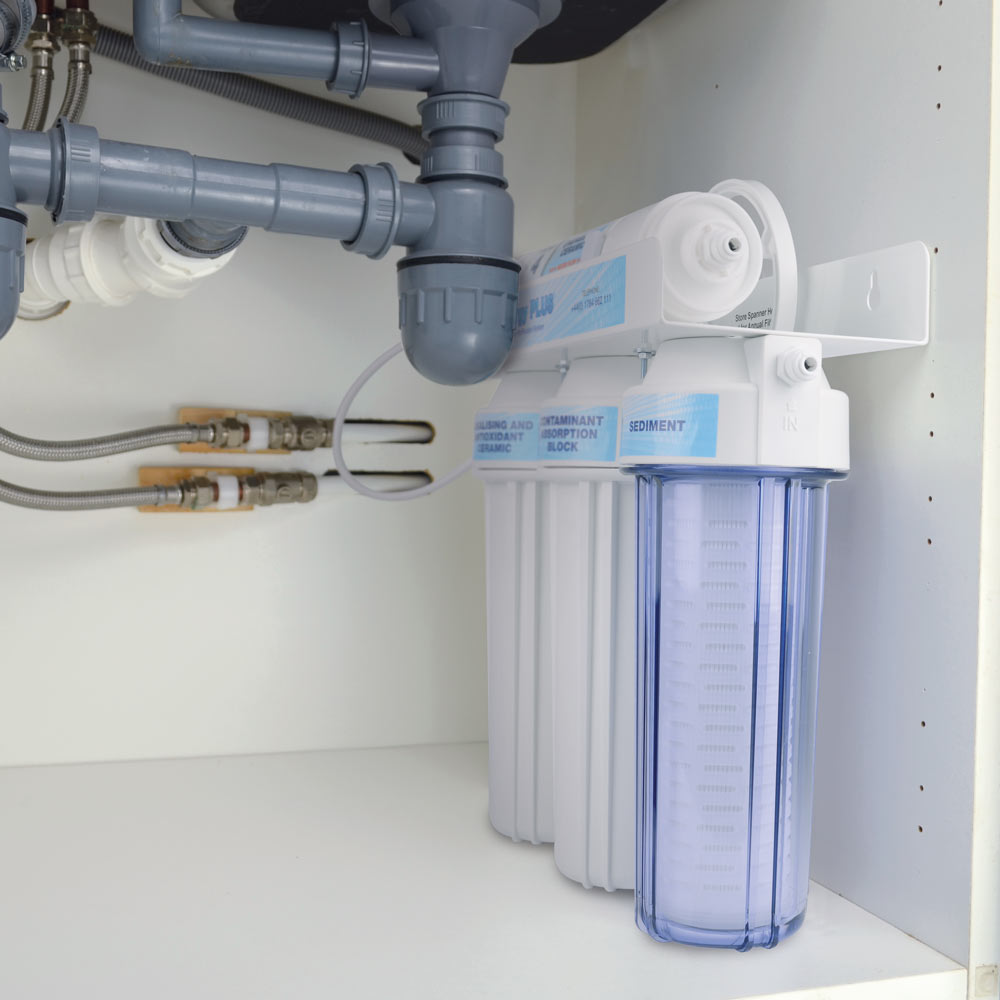
Our Drinking Water Filters and Whole House Water Filters are designed to suit different needs, from under-sink convenience to whole-property coverage. We also offer structured water devices, which help restore water's natural molecular energy for an even fresher experience. These can be used in combination with existing water filtration priocesses or as part of new systems to filter and revitalise water.
Practical ways to keep your water at its best
A few simple actions can make everyday hydration more enjoyable:
- Always draw water from the cold kitchen tap for drinking and cooking.
- If the water has been sitting in pipes overnight, let it run for a few seconds.
- Chill water in the fridge for a fresher taste; chlorine naturally dissipates after a few hours.
- Regularly maintain taps, filters, and kettles to prevent mineral buildup.
- If you live in a very old home, consider having your plumbing inspected.
- Install a quality water filter and structuring system: This is perhaps the most impactful step you can take. A properly chosen filter system transforms your tap water from merely safe into genuinely health-promoting.
Quick FAQs
Is bottled water safer than tap water?
Not necessarily. Bottled water and public tap water follow different regulations but must both meet safety standards. Tap water has the advantage of lower environmental impact and fewer plastic concerns.
Will a filter remove everything?
No single filter removes all possible substances to non detectable levels. It's best to select a model suited to your priorities, whether that's taste, scale, or health enhancing..
Why filtration fits our philosophy
At Water for Health, our mission has always been to support better hydration and wellbeing. Clean, balanced water is fundamental to how we feel each day. We believe that by improving the quality and energy of your water, you make a simple but meaningful investment in your health.
Rather than focusing on fear, we focus on enhancement - turning something that's already good into something exceptional.
Conclusion: London tap water safe to drink
London's tap water is safe and reliable, thanks to rigorous testing and oversight. Yet, its hardness and taste profile mean that many residents choose to refine it further. Many people like to reduce contaminants to even lower levels than regulatory levels.
But there's an important consideration: safe doesn't necessarily mean optimal. While London's water meets all regulatory standards for safety, those standards represent minimum requirements for public health protection - not the ideal composition for supporting peak vitality and wellbeing. Municipal treatment focuses on eliminating harmful contaminants, but it doesn't address water structure, pH balance, or the presence of beneficial minerals that can enhance hydration at a cellular level. Think of it this way: meeting safety standards ensures water won't harm you, but optimised water actively supports your health.
Adding a quality water filter system isn't about worry - it's about enjoyment, confidence, and care. With solutions from Water for Health, you can ensure every glass supports your wellbeing while tasting the way fresh water should.
To discover the right filtration system for your home, explore our full range of Water Filter Systems today and enjoy water that truly works for you. Not sure which system is best for your needs? We're happy to talk through your setup and provide the best solution for you - simply call us on 01764 662111 or get in touch through our website.
 |
 |
| Whole House Water Filters | Kitchen Water Filters |
Further Reading
- Drinking water quality in England: a triennial report 2020-2022: Detailed analysis from the regulator on the safety of public water supplies in England.
- What is hard water? Is London’s tap water safe to drink and does it affect your home?: Explains the causes and effects of hard water in London and why it is not a health hazard.
- The Water Professor – Can you drink tap water in London?: A clear overview of London tap water safety, hardness, and what you might notice at home.